Yield Loops as Conversion Machines — WAD, Gold, and Fixed Incentives

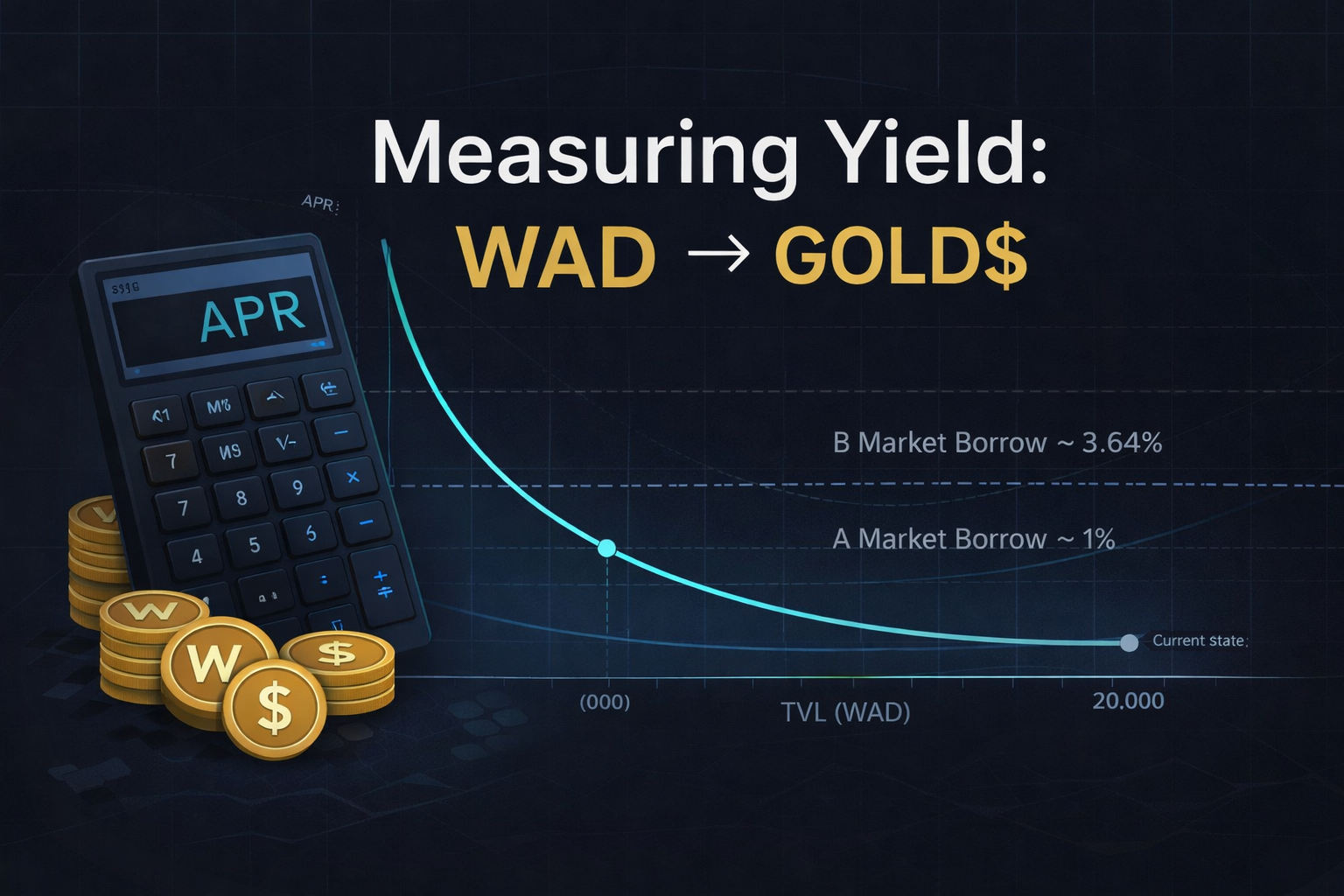
Yield isn’t yield. It’s conversion.
Most people look at DeFi incentives as “APR.”
That framing is wrong.
What’s actually happening is simpler—and more powerful:
Incentives convert capital into equilibrium.
A fixed reward pool isn’t just “yield.”
It’s a machine that pulls in capital until the return matches the cost of capital.
The mechanism
Start with a fixed incentive:
- $50 in rewards
- Distributed over 5 months
- Denominated against WAD (~$1)
The system follows a simple relationship:
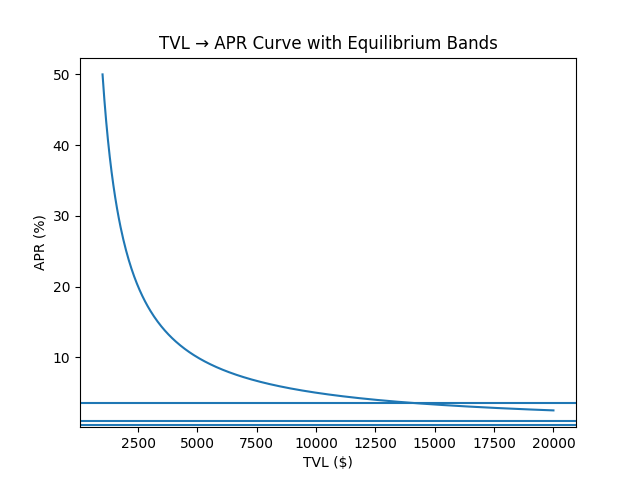
APR ≈ Reward / TVL
As capital enters:
- Early → extremely high APR
- Mid → rapid compression
- Late → slow convergence
This is not linear.
It’s a hyperbolic decay curve.
What actually determines the end state
There is no single equilibrium.
There are tiers, based on cost of capital.
Different participants require different returns:
- High-cost capital → needs ~3–4%
- Low-cost capital → accepts ~1%
- Passive capital → accepts <1%
Each group defines a band, not a point.
So instead of:
“The equilibrium is X”
The reality is:
“The system settles into a range where capital is indifferent.”
Yield loops = conversion engines
Seen this way, the system becomes obvious:
- Incentives inject value
- Capital flows in
- APR compresses
- Equilibrium forms
What you’re watching is a conversion process:
Incentives → Liquidity → Stability
Or more bluntly:
Rewards are converted into TVL.
WAD as a case study
Let’s ground this.
- Current TVL: ~$15k
- Fixed reward pool: $50 over 5 months
- Observed equilibrium: ~10k WAD
- Marginal yield at that level: ~1.02%
What does that mean?
The system is effectively creating ~10k of buy pressure.
Not instantly—but over time.
As long as incentives exist, capital is pulled in until:
- returns compress
- and new entrants stop finding it attractive
The gold analogy (but precise)
Gold doesn’t produce yield.
It stores value.
A yield loop does something different:
- It produces yield initially
- Then destroys it through competition
- Leaving behind locked capital
So instead of:
Store of value
This is closer to:
Store of converted incentives
The yield disappears.
The capital remains.
Why this matters
For LPs
You’re not “earning yield.”
You’re participating in a race to equilibrium:
- Early → extract
- Mid → compete
- Late → stabilize
For protocols
Incentives are not giveaways.
They are capital acquisition mechanisms.
The real question is:
How much TVL does $1 of incentives buy?
For markets
This is why liquidity “sticks”:
Even after incentives fade:
- capital doesn’t fully leave
- equilibrium resets, but inertia remains
Final thought
Incentives don’t attract liquidity.
They price it into existence.
Shelly Signal — mechanism notes, not financial advice.