Introducing Envoi
Web3 naming and identity are still fragmented—addresses, profiles, and metadata don’t compose. Envoi is a naming and resolver layer for a more programmable, portable internet, built with Algorand and Voi in mind.

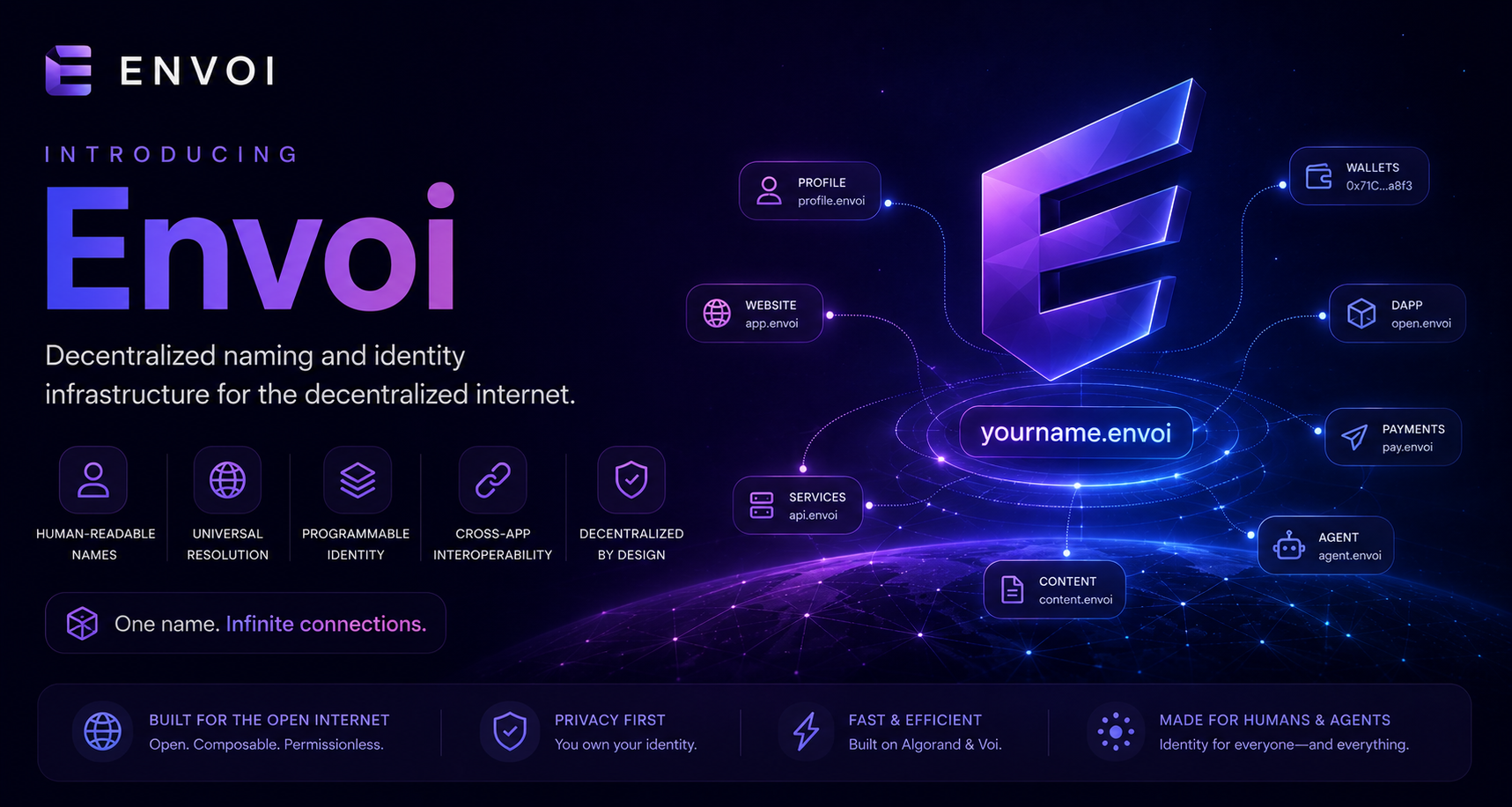
Names are one of the oldest coordination systems on the internet.
Before wallets, hashes, APIs, smart contracts, and URLs — there were names.
Names allow humans to:
- discover
- remember
- route
- organize
- trust
- coordinate
But in Web3, identity and naming infrastructure still feels fragmented.
- Wallet addresses are difficult to use.
- Profiles are scattered.
- Applications implement incompatible metadata systems.
- Cross-chain identity remains inconsistent.
- On-chain content resolution is still primitive.
We think the next generation of Web3 infrastructure needs something more unified.
That is why we are building Envoi.
What Is Envoi?
Envoi is a naming and identity infrastructure layer designed for the decentralized internet.
At its core, Envoi is focused on:
- decentralized naming
- programmable identity
- resolver infrastructure
- on-chain metadata
- portable profiles
- content routing
- cross-application interoperability
But Envoi is not just “another naming service.”
The larger vision is to create a programmable identity and resolution layer for users, applications, agents, protocols, assets, and services across decentralized ecosystems.
Why Naming Infrastructure Matters
Naming systems are foundational infrastructure.
DNS helped organize the traditional internet by creating discoverability, routing, trust, and usability.
Web3 still lacks a mature equivalent.
Today:
- addresses are difficult to remember
- profiles are fragmented
- metadata standards vary widely
- applications create isolated identity systems
- interoperability remains limited
This creates friction everywhere: onboarding, payments, governance, social identity, NFTs, applications, agents, messaging, content resolution.
A unified naming and resolver layer helps reduce that fragmentation.
Beyond Wallet Addresses
A wallet address should not be your identity.
It should be one endpoint attached to your identity.
Envoi is designed around the idea that identity should be programmable, portable, extensible, composable, and human-readable.
An Envoi name may eventually resolve to:
- wallet addresses
- profile metadata
- social links
- application endpoints
- payment routes
- agent endpoints
- decentralized content
- execution permissions
- service discovery records
Identity becomes more than ownership.
It becomes coordination infrastructure.
Resolver Infrastructure
One of the most important pieces of Envoi is the resolver model.
Resolvers allow names to dynamically point to:
- addresses
- metadata
- applications
- content
- external systems
Rather than forcing all information into a single rigid standard, Envoi is designed around flexible resolver types and extensible metadata systems.
This allows applications to evolve independently while still remaining interoperable.
We are particularly interested in:
- decentralized content resolution
- on-chain metadata indexing
- programmable records
- cross-application compatibility
- agent-readable identity systems
Identity for the Agent Era
As the internet moves toward:
- autonomous agents
- programmable execution
- machine-native payments
- AI coordination systems
identity infrastructure becomes even more important.
Agents will need:
- names
- permissions
- payment routes
- service endpoints
- execution rights
- reputations
- discovery systems
In many ways, the next generation of naming infrastructure may become coordination infrastructure for autonomous systems.
Envoi is being designed with that future in mind.
Built for Algorand and Voi
Envoi is initially being developed around the Algorand and Voi ecosystems:
- fast finality
- low transaction costs
- scalable infrastructure
- strong UX potential
These ecosystems create an opportunity to build identity systems that are lightweight, composable, accessible, and deeply integrated with applications.
Rather than treating naming as an isolated product, we see it as foundational infrastructure for the broader ecosystem.
A More Programmable Internet
One of the most exciting aspects of decentralized infrastructure is that identity becomes programmable.
A name is no longer just text in a registry.
It becomes:
- a routing layer
- a metadata layer
- a coordination layer
- an execution layer
- a discovery layer
This enables entirely new kinds of applications:
- portable profiles
- programmable payments
- agent coordination
- decentralized publishing
- cross-chain identity
- on-chain service discovery
- dynamic application routing
The internet becomes more composable.
Explore Envoi
→ envoi.sh
The Long-Term Vision
Long term, we believe identity infrastructure should:
- work across applications
- support multiple chains
- remain human-readable
- enable programmable coordination
- support both humans and agents
The decentralized internet needs better routing, better discovery, better identity portability, and better interoperability.
Envoi is an attempt to help build that foundation.
What’s Next
We are continuing to explore:
- decentralized resolver systems
- programmable metadata standards
- ENFS content resolution
- cross-chain identity
- reverse lookup systems
- application-specific resolver types
- agent-native identity infrastructure
- portable execution routing
The future internet will not just connect websites.
It will connect applications, agents, protocols, identities, and economic systems.
Envoi is being built for that future.