Introducing HumbleSwap
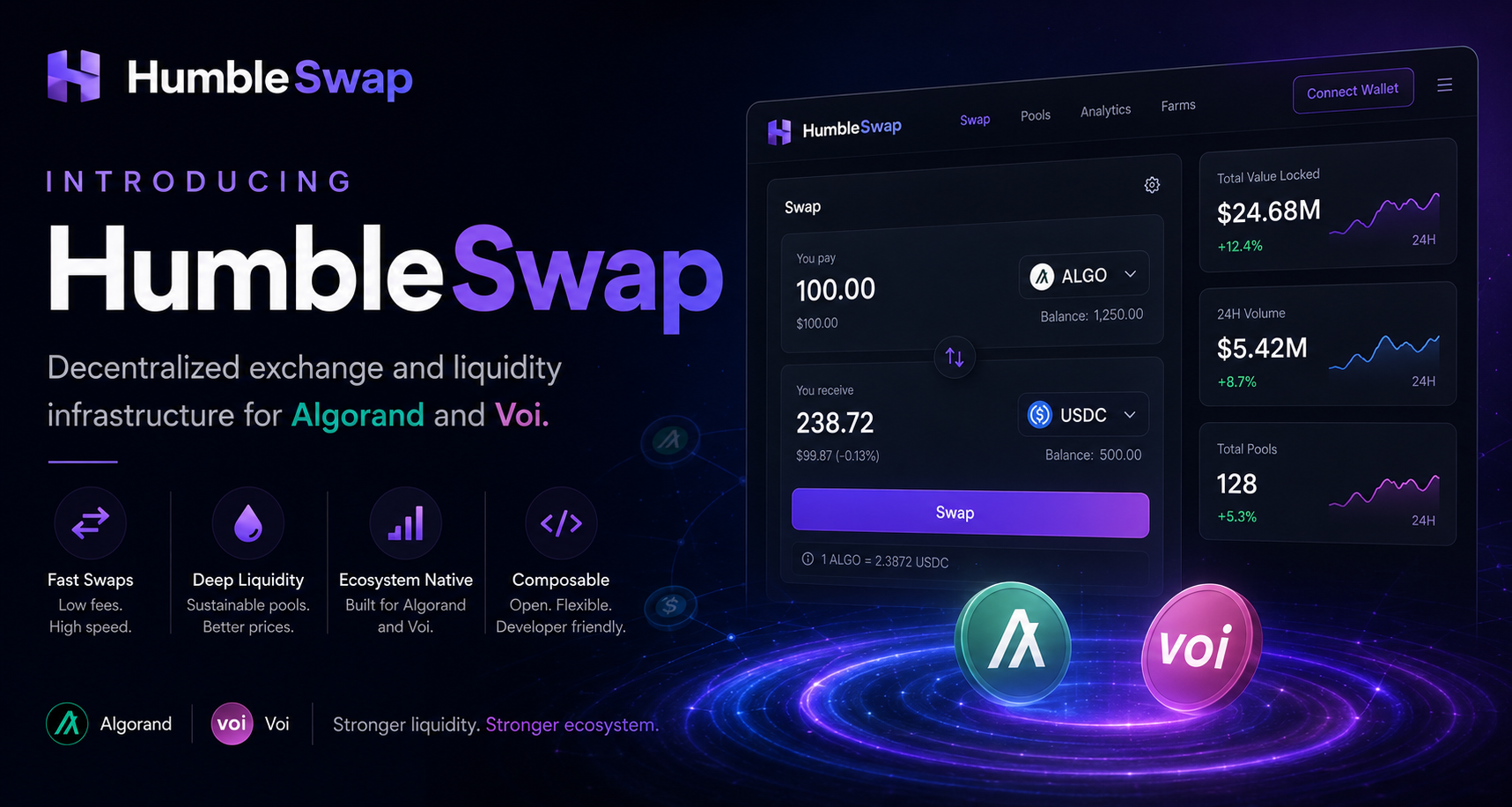
Sustainable DEX infrastructure is about liquidity coordination, reliable execution, and ecosystem alignment—not only token launches and short-term incentives. HumbleSwap is exchange infrastructure for Algorand and Voi.

There is a difference between launching a DEX and building exchange infrastructure that can survive long term.
Most decentralized exchanges begin as:
- token launches
- liquidity mining campaigns
- short-term incentives
- forked infrastructure
But sustainable exchange infrastructure requires something deeper:
- liquidity coordination
- reliable execution
- ecosystem alignment
- long-term operability
- composable primitives
That is the direction behind HumbleSwap.
What Is HumbleSwap?
HumbleSwap is a decentralized exchange and liquidity infrastructure platform focused on the Algorand and Voi ecosystems.
The goal is not simply “another swap interface.”
The goal is to build:
- sustainable liquidity infrastructure
- composable exchange primitives
- developer-friendly DeFi rails
- ecosystem-native financial coordination
HumbleSwap is part of a broader thesis: strong ecosystems require strong liquidity foundations.
Without reliable exchange infrastructure:
- onboarding becomes difficult
- new assets struggle to form markets
- applications fragment liquidity
- ecosystems lose capital efficiency
DEX infrastructure is not just a product layer.
It is economic infrastructure.
Why Liquidity Infrastructure Matters
One of the lessons from early DeFi is that liquidity becomes a coordination layer for the entire ecosystem.
Liquidity affects:
- lending
- borrowing
- governance
- stablecoins
- payments
- yield products
- NFT markets
- on-chain games
- bridges
- agent execution systems
Everything eventually routes through liquidity.
That means exchange infrastructure quietly becomes one of the most important systems in an ecosystem — not because it is flashy, but because everything depends on it.
Built for Algorand and Voi
Algorand and Voi represent a different style of blockchain architecture compared to many EVM ecosystems:
- fast finality
- low fees
- efficient execution
- strong UX potential
- scalable transaction throughput
But infrastructure still matters.
HumbleSwap is being designed around:
- ecosystem-native assets
- sustainable liquidity
- efficient execution
- composable integrations
- long-term operability
Rather than treating DeFi as isolated applications, we view the ecosystem as an interconnected financial network.
Beyond Swaps
The future of exchange infrastructure is larger than token swapping.
Modern liquidity systems increasingly connect to:
- lending markets
- collateral systems
- staking
- governance
- cross-chain routing
- agent-based execution
- automated treasury management
At Nautilus Labs, we think a lot about how these systems converge.
For example:
- DEX liquidity may feed oracle systems
- lending markets may route through exchange infrastructure
- agents may execute swaps autonomously
- governance systems may coordinate liquidity incentives
- payment layers may interact directly with routing systems
Over time, the line between DEX, financial middleware, and execution infrastructure starts to disappear.
Sustainability Over Hype
One of the challenges in DeFi is that many systems optimize for:
- short-term TVL
- emissions
- temporary incentives
- speculative activity
But durable infrastructure requires:
- sustainable economics
- careful risk management
- operational discipline
- ecosystem alignment
We believe long-term liquidity infrastructure should focus on:
- reliability
- composability
- accessibility
- ecosystem utility
- developer integration
Not just temporary growth metrics.
The Long-Term Vision
The broader vision behind HumbleSwap is to help create:
- more connected liquidity
- easier financial coordination
- programmable exchange infrastructure
- accessible on-chain markets
As the ecosystem evolves toward:
- autonomous agents
- programmable execution
- cross-chain workflows
- machine-native payments
liquidity infrastructure becomes even more important.
Because ultimately: execution needs markets. And markets need liquidity.
Explore HumbleSwap
The next generation of decentralized infrastructure will not be built from isolated products.
It will emerge from interoperable economic systems working together.
HumbleSwap is one piece of that future.