xChain is Live on DorkFi

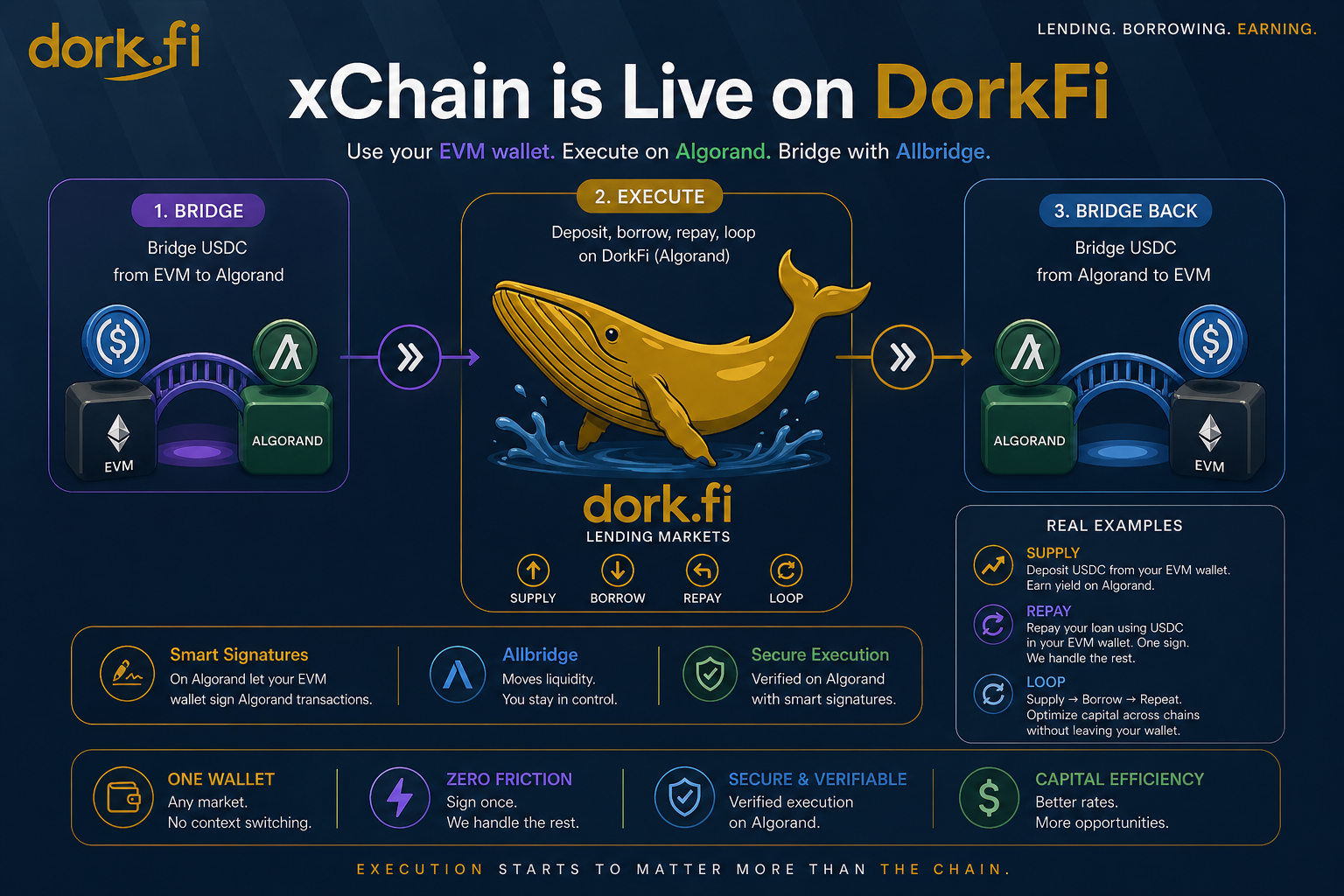
I came across this tweet from the Algorand Foundation and that's how I found out xChain was rolling out.
Admittedly, I already knew this was possible.
That's the part that makes it exciting.
Because when something like this shows up, it's not the beginning — it means the hard work is already done. The infrastructure is there. The pieces have been built, tested, and connected.
This is just the moment it becomes visible.
Can't tell you what might come next…
But if you've been paying attention, you probably already have an idea.
What xChain Actually Does
xChain isn't just "cross-chain."
It works because of two pieces coming together:
- Smart signatures on Algorand
- Liquidity bridging via Allbridge
Instead of forcing users to switch wallets or learn a new chain, xChain lets an EVM wallet act as the signer while execution happens on Algorand.
The Flow
At a high level:
- Bridge USDC from EVM → Algorand
- Deposit into DorkFi lending pool
- Bridge back to EVM
But from the user's perspective:
- You stay in your EVM wallet.
- You sign once.
- The system handles the rest.
Why This Matters
This isn't about removing chains.
It's about using the right chain for execution without forcing users to adopt it directly.
- Algorand handles execution efficiently
- EVM wallets remain the interface
That's the separation:
execution layer vs user layer
Real Example: What You Can Actually Do
This is where it clicks.
Supply
You hold USDC in your EVM wallet. You deposit into DorkFi.
Under the hood:
- USDC is bridged via Allbridge
- Funds are supplied into Algorand markets
- You start earning yield
No wallet switching. No manual bridging steps.
Repay
You have an existing borrow on DorkFi. You repay using USDC from your EVM wallet.
The system:
- bridges the funds
- executes repayment on Algorand
From your perspective:
Just sign and it's done.
Loop (Advanced)
Deposit USDC, borrow against it, optionally route capital back out.
This opens up:
- cross-chain leverage strategies
- yield optimization
- unified capital management
All without managing multiple ecosystems manually.
Why We're Shipping This Now
At Dork Labs, we operate with a bias for action.
Same principle you see at Amazon — ship, learn, iterate.
So instead of talking about what's coming…
We shipped it.
No long lead-up. No over-explaining.
Put it in users' hands and see what happens.
Because you don't learn from planning.
You learn from usage.
Subtle Shift (If You're Paying Attention)
There's a deeper idea here.
xChain today focuses on EVM wallets, but the underlying model isn't tied to EVM.
If a chain can verify a signature, it can execute on behalf of that signer.
That means:
- wallets become signers
- chains become execution layers
And once you see it that way, the question changes from:
"Which chain am I on?"
to:
"Where should this execute?"
We're not fully there yet.
But this is one of those moments where the direction becomes obvious.
Final Thought
This isn't just about bridging.
It's about reducing the amount of context a user needs to operate across systems.
Less switching. Less friction. More execution.
This is what it looks like when execution starts to matter more than the chain.