The Agent Economy Is Following the Same Path as Web3
The real transition in AI agents may not be intelligence—it may be economics. Agents are moving from isolated tools toward autonomous economic participants, and payments are the missing link.

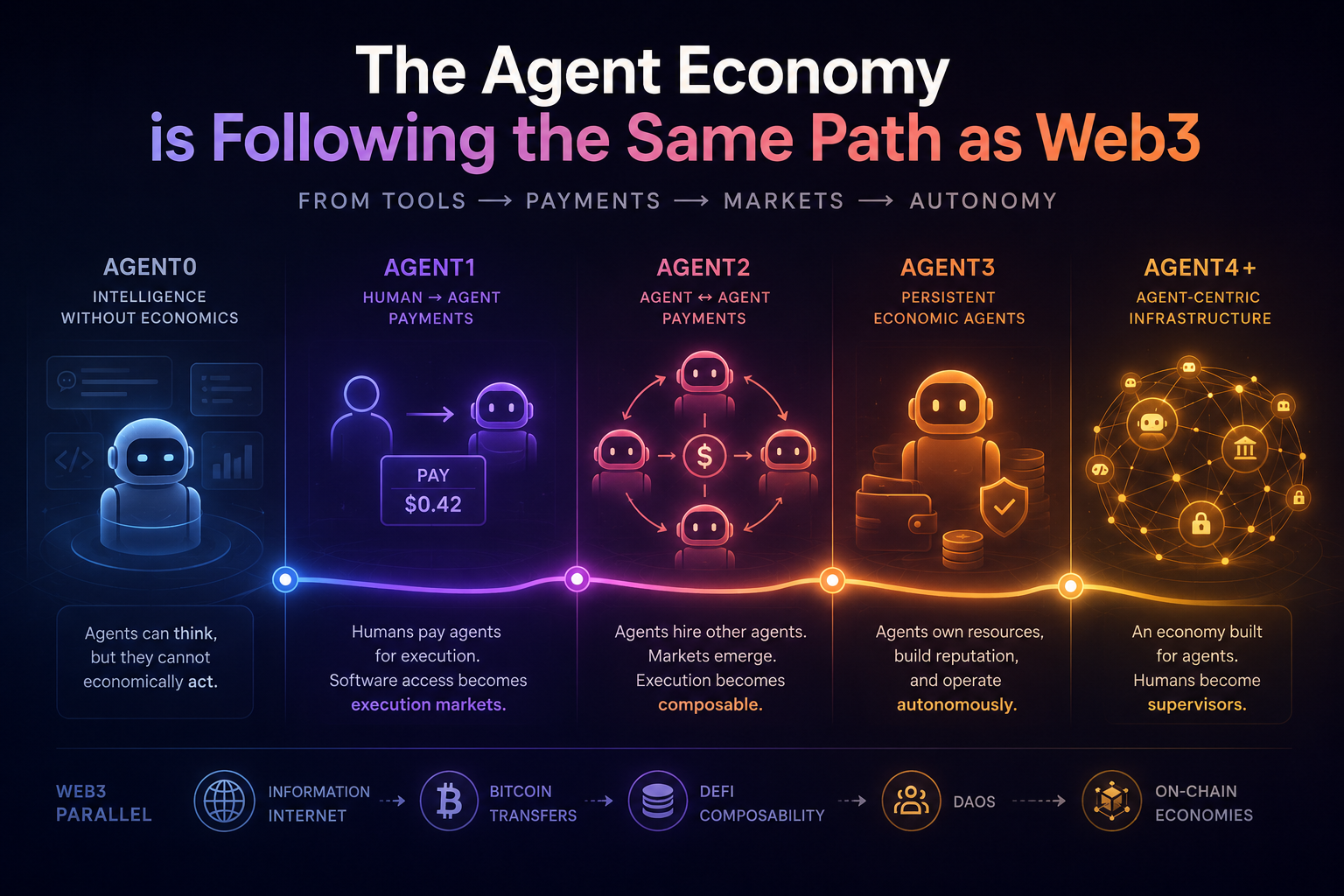
For years, the conversation around AI agents has focused on intelligence: better models, longer context windows, reasoning, planning, memory.
But the real transition may not be intelligence at all.
It may be economics.
My thesis is that agents are following a progression very similar to the early evolution of Web3 — moving from isolated tools into autonomous economic participants.
And the missing piece connecting those stages is payments.
Agent0 — Intelligence Without Native Economics
This is where most AI systems exist today.
Agents can:
- answer questions
- generate content
- call APIs
- automate workflows
But economically, they are still trapped inside traditional SaaS infrastructure.
Humans pay:
- subscriptions
- API bills
- enterprise contracts
The agent itself cannot independently transact.
This is the equivalent of the pre-Web3 internet: highly useful systems with no native value layer.
The result: agents can think, but they cannot economically act.
Agent1 — Human → Agent Payments
This is the transition we are entering now.
Protocols like x402 are introducing something fundamentally different: native, programmable payments for execution itself.
Instead of paying monthly for software access, users begin paying:
- per workflow
- per execution
- per result
- per action
The important shift is subtle but massive: software access is replaced by execution markets.
A human no longer buys “an application.” They buy “an outcome.”
This changes the shape of software entirely.
Examples:
- repay a loan
- bridge assets
- claim rewards
- rebalance a portfolio
- monitor governance
- execute a liquidation
All become individually purchasable execution flows.
This is where systems like x402, payment-gated APIs, agent execution networks, popup payment layers, and wallet-native workflows start becoming foundational infrastructure.
At Nautilus Labs, we’ve been exploring this through systems like Nautilus Agent Pay: a lightweight payment layer that allows applications to trigger agent execution through a popup flow instead of forcing every app to implement custom payment infrastructure.
Conceptually, it feels closer to “Stripe Checkout for agent execution” than traditional crypto UX.
Agent2 — Agent ↔ Agent Payments
This is where things become truly different from SaaS.
In the next phase, agents stop operating as isolated assistants and begin operating as economic actors.
Instead of human → application, we move toward agent → agent coordination.
A future workflow might look like this:
- A user pays a routing agent
- That agent hires: a bridge agent, a swap agent, a risk agent, a settlement agent
- Each agent is paid independently
- Execution completes autonomously
At this stage:
- APIs become marketplaces
- execution becomes composable
- agents outsource work dynamically
- workflows become recursive economic graphs
This starts looking remarkably similar to early DeFi composability — not because it uses tokens, but because it uses programmable economic coordination.
Agent3 — Persistent Economic Agents
Eventually agents stop being temporary sessions and become persistent entities.
They may hold:
- wallets
- treasuries
- positions
- reputations
- execution rights
- delegated authority
An agent no longer merely executes a task. Instead, it:
- manages capital
- optimizes workflows
- negotiates services
- monitors risk
- reinvests resources
- coordinates with other agents
This is where concepts like agent-owned positions, execution rights NFTs, autonomous refinancing, programmable delegation, and machine-native credit systems start becoming realistic architectural primitives.
The line between protocol, application, automation, and participant begins to blur.
Web3 Didn’t Just Decentralize Value
One of the reasons this pattern feels familiar is because Web3 already demonstrated the progression.
| Web3 Evolution | Agent Economy Evolution |
|---|---|
| Bitcoin transfers | Human → agent payments |
| Smart contracts | Autonomous workflows |
| DeFi composability | Agent ↔ agent execution |
| DAOs | Multi-agent coordination |
| Wallet infrastructure | Agent identity/execution |
| Appchains & rollups | Specialized execution agents |
But there’s a key difference.
Web3 decentralized value transfer.
The agent economy may decentralize execution itself.
Why x402 Matters
A lot of people view x402 as a crypto payment primitive, a micropayment protocol, or an API monetization layer.
But I think it may represent something larger.
x402 creates a bridge between intelligence and economic action.
That transition matters because autonomous systems require autonomous settlement.
- Without payments: agents remain features.
- With payments: agents become participants.
And once agents can pay, hire, coordinate, outsource, and settle, the architecture of software changes completely.
The Long-Term Shift
I suspect we are still very early.
Most agents today are still firmly in the Agent0 era: useful, intelligent, but economically dependent.
But the infrastructure stack is beginning to emerge:
- x402
- agent wallets
- programmable authorization
- execution networks
- workflow routers
- cross-chain settlement
- capability marketplaces
The interesting part is that this evolution may happen faster than Web3 did — because unlike early crypto, there is already massive demand for automation.
The missing piece was never intelligence alone.
It was native economic coordination between machines.