When Your Protocol Is Bigger Than Its Market
WAD, cross-chain supply, and why most of it doesn’t have a price yet

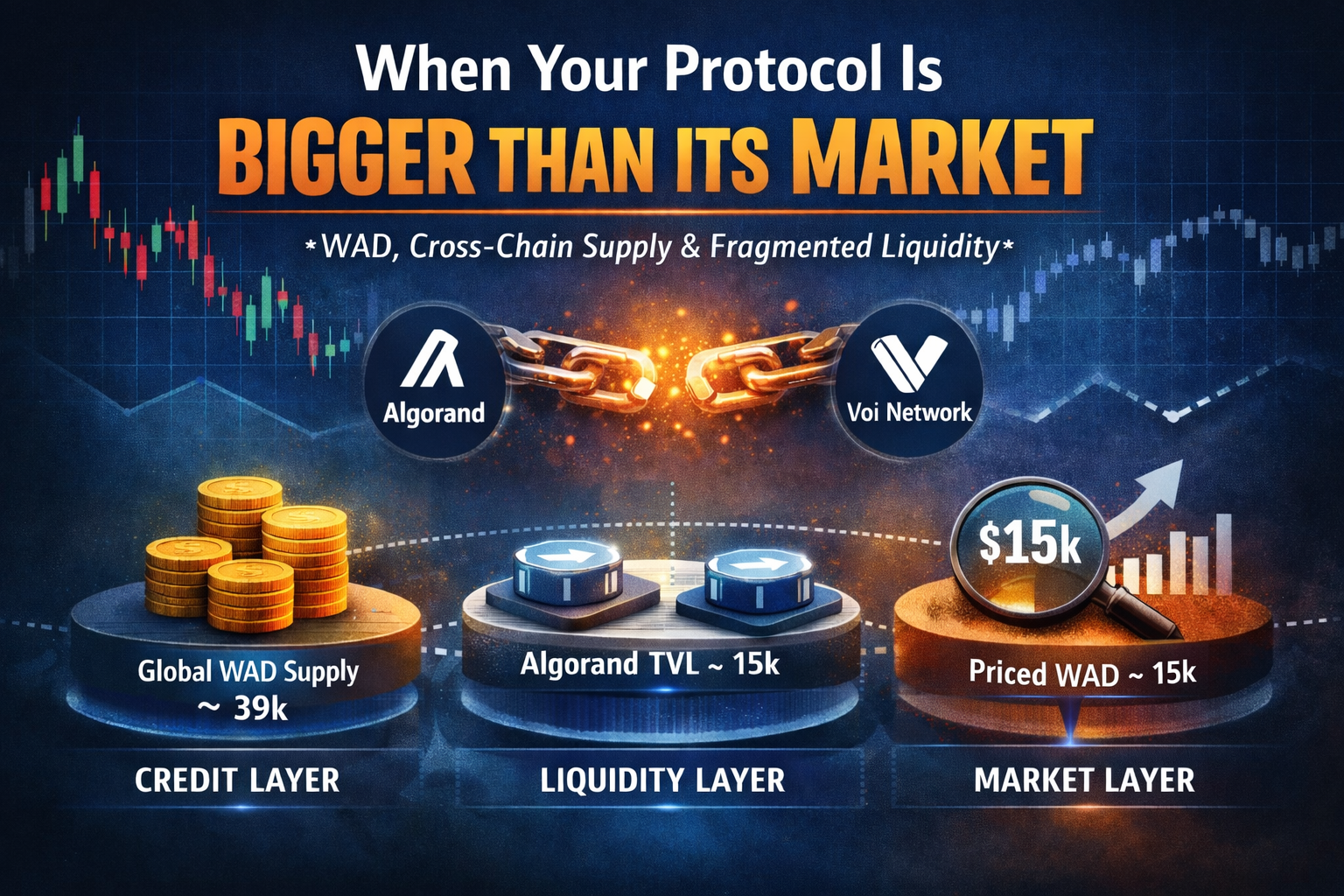
There’s a phase where protocol metrics stop lining up.
Supply looks large. TVL looks reasonable. But the “market” looks… smaller than both.
That’s where WAD is right now.
What the market sees (Algorand)
Looking only at DEX data on Algorand:
- Price: ~$0.97
- DEX TVL: ~$15k
- Market Cap (Haystack): ~$15k
You can explore WAD directly on Vestige and Hay.
At a glance, this looks like a small, slightly discounted market.
But this is only part of the system.
What actually exists
Total WAD in circulation: ~39k
- ~23k on Algorand
- ~16k on Voi Network
So: more WAD exists than the market is actually pricing.
The more subtle truth
At first glance, the numbers don’t line up:
- ~23k WAD on Algorand
- ~$0.97 price
- Yet market cap appears closer to ~$15k
That looks inconsistent — until you realize: market cap isn’t reflecting total supply. It’s reflecting active liquidity.
What “market cap” really means here
In traditional tokens:
Market cap = supply × price
But WAD isn’t a traditional token. It’s:
- Borrowed into existence
- Distributed across chains
- Mostly held outside of LPs
So instead:
Market cap ≈ the portion of WAD participating in price discovery
And right now:
- ~$15k in liquidity → defines the market
Three layers of WAD
To understand the system, break it into layers:
- Credit Layer (~39k WAD) — All WAD across both chains → the true system size.
- Liquidity Layer (~15k TVL) — What’s actually in pools → what can be traded.
- Market Layer (~$15k “market cap”) — What is actively priced → what the market recognizes.
The key insight
Only a fraction of WAD is being priced.
On Algorand:
- ~23k WAD exists
- ~$15k TVL is what’s in the pool — thin relative to float, but it’s what prints the tape
Globally:
- ~39k WAD exists
- Still ~$15k in pooled liquidity doing most of the work for what dashboards call the “market”
What’s happening at $0.97
WAD trading below peg tells you:
- Slight excess supply locally
- Sell pressure from borrowers or LP imbalance
- Not enough demand sinks yet
This is not failure. This is real price discovery.
Cross-chain fragmentation
WAD is split across:
- Algorand (~23k)
- Voi Network (~16k)
Each has its own liquidity, its own pricing, its own imbalances.
There is no unified WAD market yet.
Why this is actually bullish
Most tokens have liquidity but no real usage. WAD is the opposite:
- Borrowed into existence
- Actively used
- Distributed across chains
That means: the system is growing faster than its markets can represent it.
The real bottleneck
It’s not supply. It’s not demand.
It’s liquidity representation — more specifically:
- Too little WAD in pools
- Too much WAD outside of price discovery
What comes next
To close the gap:
- Deeper liquidity — more WAD participating in markets
- Cross-chain balancing — arbitrage between Voi and Algorand
- Stronger demand sinks — more reasons to hold WAD vs sell it
The transition phase
WAD is moving through a natural progression:
- Supply expansion ✅
- Cross-chain distribution ✅
- Fragmented liquidity (current) ← you are here
- Liquidity convergence (next)
Final takeaway
If you only look at dashboards, you’ll miss it.
39k WAD exists. Only ~$15k in liquidity is defining the visible market.
So: most of WAD doesn’t have a price yet — and that’s not a problem.
It’s a phase.
CTA
If you’re using WAD:
- Are you providing liquidity?
- Are you helping stabilize a market?
- Are you bridging demand across chains?
Because right now:
The opportunity isn’t just in using WAD — it’s in helping it get priced.