April in Pad — What Shipped
Pad tells the story of eighteen workspaces and fifty-five completions in one month—here’s the arc.

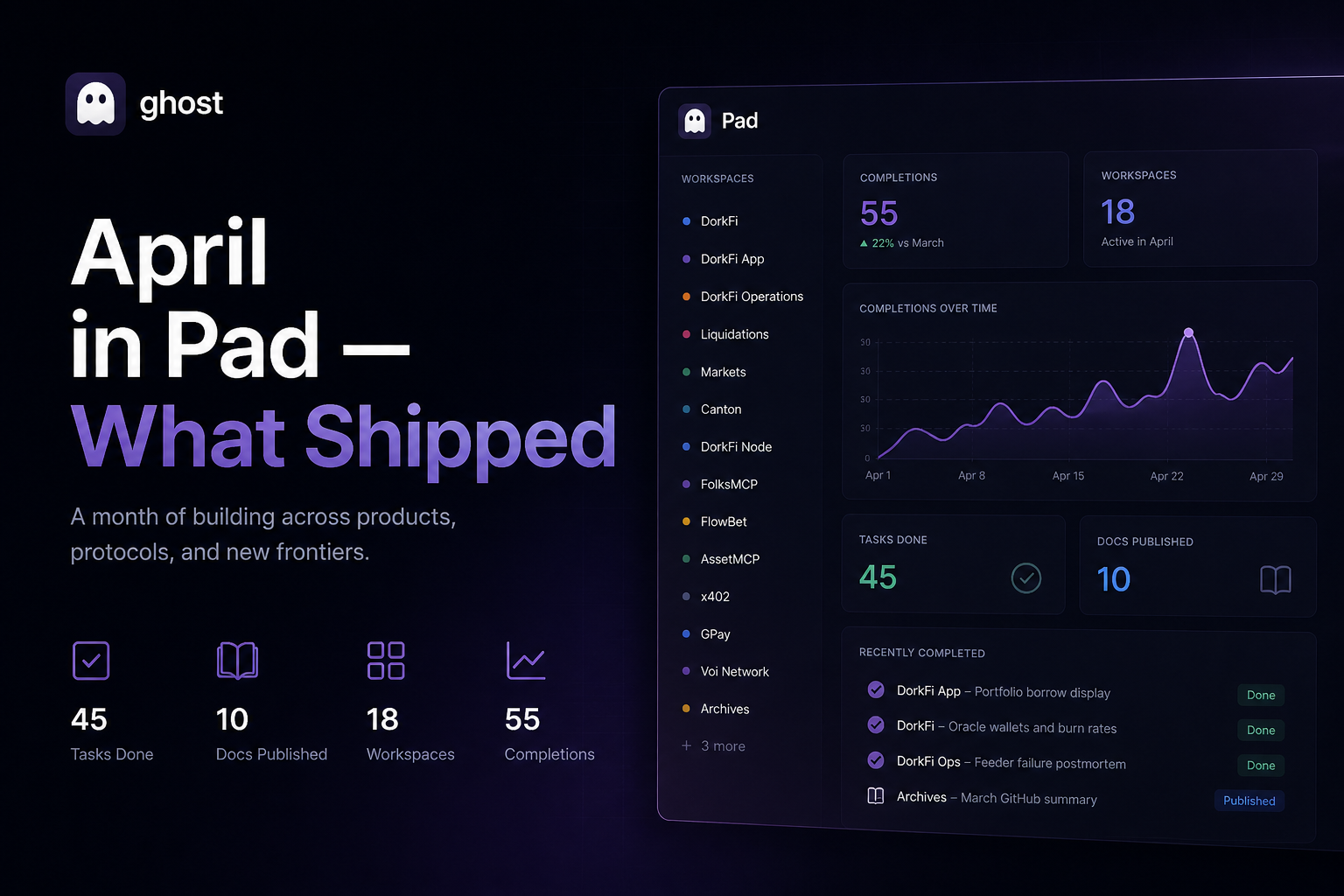
April was one of those months where the shape of the work is obvious only after you step back. I use Pad (structured notes, tasks, and docs per workspace) as the system of record for what’s in flight across repos, products, and ops. When I pulled a simple cut—“items in a terminal done state that moved in April”—the picture was clearer than any single standup could have been.
TL;DR
- 55 completions across 18 workspaces
- 45 tasks done, 10 docs published
- One big DorkFi app release batch + steady core protocol work
- Data is based on last updated in April (good enough for narrative, not audit)
Highlights (outside Pad)
Not everything important shows up as a “done” task. A few things worth calling out:
- DorkFi: Progress on D-Markets and xChain integration
- New Product: LendPay — repay DeFi loans across chains in one flow
- Hackathon: Built LendPay during ETHGlobal Open Agents
- Voi Network: Work on GPay and a Governance Payout Framework
The headline numbers
Across all workspaces, I counted 55 items that looked “finished” in April: 45 tasks marked done and 10 docs marked published. Those completions landed in 18 different workspaces—not bad for a portfolio that spans lending, infra, taxes, MCP servers, and a long tail of side quests.
I’m explicit about what that number isn’t: Pad doesn’t give me a dedicated “completed at” timestamp, so I’m using last update in April as a proxy. That’s good enough for a monthly narrative; it’s not audit-grade. If I edited a done task in May, it would disappear from this slice—and if I touched an old done item in April, it would show up. For a blog post, that’s fine. For a board deck, I’d tighten the definition.
Where the weight sat
DorkFi App + Core protocol work
Twelve tasks in the dorkfi-app workspace share the same April 21 timestamp—classic “I closed the loop on a release batch” energy. The titles read like real product work: portfolio borrow display, governance empty states, market modal behavior, intrinsic APR, health-factor copy, and a pile of UI hardening.
Alongside that, the main Dorkfi workspace carried ten completions—everything from execution roadmaps and market ops (SOD floor, SOL emergency pause) to a long-form “oracle wallets and burn rates” write-up and post-merge PR summaries. DorkFi Operations logged three done items that smell like production firefighting (feeder failures, audit/sync, market pauses). Liquidations and Markets each had two closes that line up with “I’m running a live protocol, not a slide deck.”
Smaller but telling: Canton validator setup landing alongside DorkFi Node, FolksMCP and FlowBet doc/txn improvements, AssetMCP and x402 follow-through, a GPay demo-prep task, and an Archives doc publishing a March GitHub summary. That’s the long tail of a real R&D shop—one item per line, but the lines add up.
What I’d tell myself in hindsight
April’s activity wasn’t evenly distributed across days—and that’s information, not noise. You can see batch closes, you can see tax-season clustering, and you can see the difference between “exploring” and “published.” If I wanted a cleaner month-over-month chart next time, I’d standardize how I mark completion and maybe add a convention for “release batch” vs “single ship” so the analytics don’t look like a heartbeat glitch.
Still: fifty-five completions across eighteen workspaces is a defensible answer to “what happened last month?” without opening every repo’s commit graph.
Closing
If you’re building in public—or even in semi-public—activity last month shouldn’t be vibes. It should be something you can query. For me, right now, that query is Pad-shaped, at getpad.dev. May’s post will be better if I tighten how I record completion; April’s post is honest about the proxy I used and the story it still tells.
Method note for readers who care: items counted if status ∈ {done, published, completed, implemented} and updated_at fell in April 2026 UTC.